
Transforming Into a Data-Driven Smart Factory via the 'AI Temperature Prediction & Control Model'
Conquering 122 Million Cumulative Data Points to Achieve Autonomous Operation, Slashing Fuel Costs, and Boosting Workforce Flexibility
South Korea’s glass bottle manufacturing sector is evolving rapidly. The industry is building an advanced smart factory ecosystem by embedding artificial intelligence. Through the successful development of the “AI Temperature Prediction and Control Model” at the Gunsan Plant, the facility has achieved remarkable milestones. It optimizes furnace temperature control while significantly boosting overall operational efficiency.
■ Shifting the Core: From Veteran Intuition to AI Furnace Systems
Traditionally, furnace operations heavily relied on the experience of veteran workers. They managed energy input tailored to specific product lines based on intuition. However, this human-dependent approach led to variations in energy efficiency across shifts. It also hindered overall operational productivity. Operators could rarely leave their posts due to the ultra-high-temperature environment.
To overcome this bottleneck, the Gunsan facility benchmarked POSCO’s smart blast furnace model. The team collaborated with AI specialists to build a cutting-edge AI furnace system. This system is specifically customized for glass bottle manufacturing.
■ Achieving Stable Control via the AI Furnace Evolution
The development of this new model has been executed with meticulous precision. The team used sequential, data-driven stages since 2022:
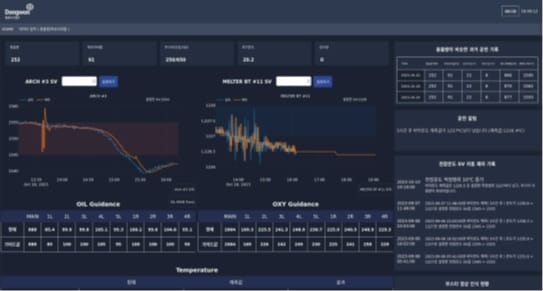
Phase 1 (Prediction Model Development): Analyzed the melting process and trained the AI on 27 million data points. This developed and visualized predictive models for critical variables like internal temperature and oil flow rates.
Phase 2 (Model Optimization): Expanded the training dataset to 81 million data points. The team integrated real-time booster power metrics and utilized OCR technology to digitize dashboard gauges. This drastically improved prediction accuracy.
Phase 3 (Stabilization & Integration): Leveraging a massive database of 122 million data points, the plant implemented PLC integrated operations. The facility successfully achieved up to 4 hours of continuous autonomous operation. It established a seamless real-time control architecture for the AI furnace.
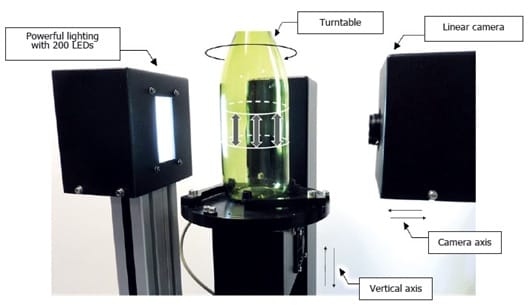
[Source: Smart Manufacturing Innovation Report 2026 / Deployed AI System & Quality Data Measurement Device]
■ Driving Both Energy Efficiency and Superior Quality
The impact of the new technology is clearly proven by empirical data. Most notably, temperature fluctuations have been drastically minimized. Under conventional manual control, the furnace frequently drifted outside the optimal target temperature of 1,370°C.
In contrast, the smart AI furnace leverages predictive data. It proactively adjusts to conditions 5 minutes in advance, maintaining steady operations strictly within the target range. This stability has successfully reduced fuel costs and extended the operational lifespan of the furnace. It also sharply suppressed product defects.
Furthermore, the workplace environment has undergone a massive transformation. Daily temperature monitoring tasks previously required up to 3 hours of intense labor. These tasks have now been minimized. This allows the plant to optimize shift staffing from 3 operators down to 2, thereby securing exceptional workforce flexibility.
■ Overcoming Key Challenges and Future Outlook
Glass manufacturing involves simultaneous raw material melting and fuel combustion. Because of this complexity, any failure in temperature prediction carries the risk of large-scale manufacturing defects. The Gunsan team conquered these sophisticated engineering hurdles. They successfully decoded the complex correlations between temperature sensors and burners, alongside resolving uncertainties in booster operation patterns.
“This is a profound evolution into a data-driven precision manufacturing system,” a plant official stated. Moving forward, the facility plans to further advance the AI furnace model. They will integrate it with real-time quality measurement data, such as monitoring for bubbles and seed defects, to systematically unlock the absolute optimal operating conditions.